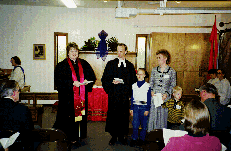
At 4 p.m., the first Evening Prayers and worship study is conducted in a home, under the name of “Epworth-in-the-Foothills”. The Evening Prayers are lay-led, and Dr. C. Griffith Bratt is pianist.
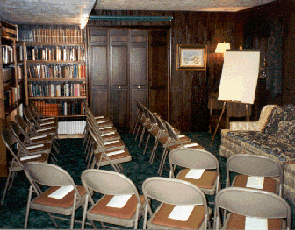
All is ready for the first Epworth worship study, on January 31, 1999, in the “Epworth library”.
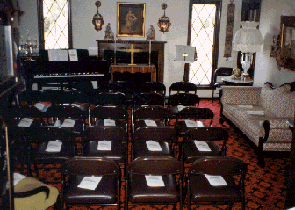
All is ready for Epworth’s first Evening Prayers service, conducted January 31, 1999, in the living room of a home.
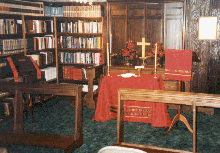
The Rev. Dr. Diane K. Leclerc of Northwest Nazarene University begins being the leader of the Evening Prayers services.
In accord with the informal decision that Epworth will become a church rather than a temporary series of gatherings for study and prayers services, Epworth’s services move to 7 p.m. on Epworth’s first Trinity Sunday. Pat Nelson is organist.
The Epworth Hymnal goes into use, with 12 hymns contained within it.
At the suggestion of Lilburn Wesche and with him as the regular leader, Epworth begins having post-service discussions of “the sermon, liturgy, hymns, whatever”, as The Harbinger of May 26, 1999, put it.
Epworth’s first Pentecost Sunday service.
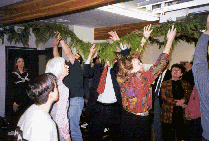
Epworth’s first greening-of-the-church service requires an ability to work well with others.
Epworth’s first “choir” practice–to enable all who wish to do so, to practice the following Sunday’s hymns–occurs in the home of Carollen Ryan, as her idea and invitation. Pat Nelson is pianist, substituting for Esther Wesche.
Soprano Deniece Miller of Northwest Nazarene University becomes Epworth’s first intern as a cantor.
The Rev. Dr. Brook Thelander serves his first Sunday as Epworth’s pastor, although the Rev. Lori Ward preaches.
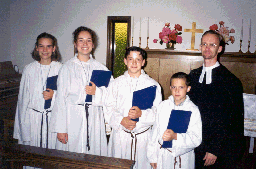
Epworth conducts its first induction of acolytes.
Epworth switches from an evening-service schedule to a morning service schedule. Pastor Thelander begins a 9 a.m. Sunday course on Wesleyan Theology and Thought.
John Bostron becomes Epworth’s regular Sunday-morning organist.
Epworth purchases a new Rodgers 525 electronic organ, to replace the earlier Conn organ, suddenly and explosively defunct.
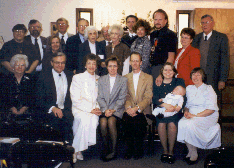
Epworth’s first members
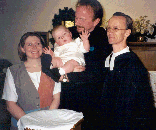
Patrick Nels Millar with his parents, Robyn and Keith, and with Pastor Thelander
The Epworth board discusses re-locating somewhere on an interim basis, until a suitable property can be found.
The Property Committee, through Don Hughes, chairman, reports to the Epworth board that a former church building on 28th Street has too many problems for us to consider further.
“The Committee has looked at a church on Northview, priced at $265,900, and which would seat 165. Also they have looked at property being constructed at 27th and Bannock, for purchase or lease. Purchase price, $562,000. Lease, $2,500 monthly.
“A sheet analyzing our property needs was handed out and discussed in an attempt to aid the Property Committee with its assignment. The consensus was that we need a building as soon as possible, always keeping in mind a longer range goal for a Retreat Center.
“. . . . The general consensus was that a retreat center was equally as important as the church, but that we should go ahead and find a place for the church first without regard to the retreat plans at this time.”
The Epworth board inspects the property at 6110 Northview Street. After discussion and prayer, the board authorizes the purchase of the property.
The Epworth board authorizes exploration of establishing relationships with a person of the clergy in the Wesleyan tradition and another in the Anglican tradition, for each to serve “as a corporate spiritual overseer without legal power or authority” for Epworth.
“Anonymous Statement of Intention to Contribute” cards are mailed to Epworthies, so that their unidentified responses will provide a reading on the likely level of support for the renovation, remodeling and upkeep costs of the new-to-us building and property at 6110 Northview Street.
Although the “Anonymous Statement of Intention to Contribute” cards were not pledges, the first building-fund contribution comes in, and others follow.
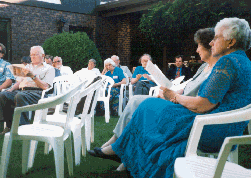
Epworth conducts the outdoor “Six Summer Sundays” of joint study and worship (that part indoors) with Light of the Cross Fellowship, with a view to the possibility that the two congregations might become one. They didn’t.
Epworth’s first Wesleyan overseer accepts that position.
The Rev. Dr. William Greathouse, Epworth’s first Wesleyan overseer, meets with the Epworth board and spouses for dinner, and attends a specially arranged Evening Prayers service following.
The closing occurs, and Epworth takes possession of the 6110 Northview Street property.
Epworth creates the Lend All You Can Plan, to help finance remodeling and renovation work at 6110 Northview Street.
The heating and cooling system for the north one-half of the sanctuary is replaced. The replaced unit was found to have a cracked (and dangerous) heat exchanger, but it was already known at the time of purchase to have been at the end of its useful life.
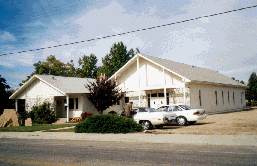
The property at 6110 Northview Street, as it was “before”: with the prior owner’s large stone in front, old roof, even an old car in front.
The board reverses the priorities for the remodeling and renovation work. It was known when we purchased the building that the building needed to be re-roofed, but after purchase we found that the condition of the building’s roof and attic was even worse, with rot in the shingles, fabric liner and plywood under them; hay or straw in the attic; and no, little or blocked venting.
The previous plan had been to do only the “minimum-to-occupy” work and then immediately to occupy the building. Other, longer-term work would come later. Because of the serious condition and fire hazard of the roof and attic, the board approves the Property Committee’s recommendation to proceed with replacement of the entire roof structure over the sanctuary/nave, and with the full remodeling and renovation of the interior of the sanctuary/nave and parish hall, all before occupying the building.
Architectural and engineering work seems to drag on and on, without much visible progress. In the meantime, Epworth’s committees hold brain-storming sessions regarding how Epworth will be able to serve our neighborhood and parish surrounding 6110 Northview Street.
Disappointed by the time it was taking, without end in sight, to complete the architectural work, the Epworth board reverts to the earlier plan, to do the necessary work to enable occupancy of 6110 Northview Street, now on the first Sunday of Advent, December 2, 2001. Work begins immediately to remodel and renovate the parish hall and otherwise to make the building usable, with Drew Construction, Inc., as the contractor.
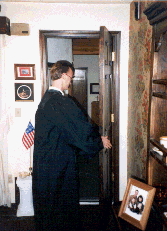
On the last day of services at Epworth-in-the-Foothills Chapel, the Rev. Dr. Brook Thelander ceremoniously returns the chapel to secular use and closes the chapel door for the last time.
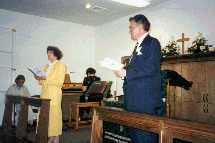
Rev. Dr. Brook Thelander ceremoniously returns the chapel to secular use
Immediately preceding the first service at 6110 Northview Street, Pastor Thelander consecrates the sanctuary/nave for worship. Epworth conducts its first service at 6110 Northview Street, now under the new name, “Epworth Chapel on the Green”
The dedicatory service for the Epworth Chapel
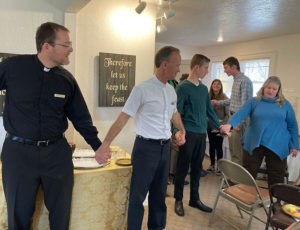
Epworth’s name legally becomes “Epworth Chapel on the Green, Inc.”
Epworth’s board revises the self-description of Epworth which had been adopted on August 29, 2000, to add an emphasis on greater unity, understanding and communion among orthodox Christian churches and denominations.
Epworth hosts the first instance in America for a local congregation to experience simultaneous oversight from both the Wesleyan and Anglican traditions.
Epworth dedicates its memorial garden on Easter Sunday.
Christ the King Sunday